
Low carbon economy
Climate change is one of the most significant challenges of our time. As a leading provider of novated leasing and fleet management services, MMS is well positioned to support the transition to a lower-carbon economy. We do this by reducing the environmental impact of our own operations and helping customers make more sustainable transport choices.
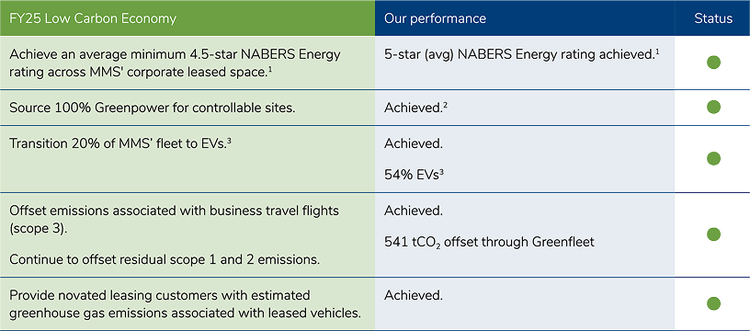
1. Includes all MMS corporate offices with 30 or more people (excludes Perth, Raymond Terrace and Just Honk car yards). In FY25 it excludes MMS’ Adelaide officedue to building works which required our people to work from home for extended periods.
2. Controllable sites are where MMS can choose the electricity provider using the existing building infrastructure.
3. MMS Australia and New Zealand car fleetat 30 June 2025 is Battery electric vehicles (BEV) and plug-in hybrid electric vehicles (PHEV).
Low carbon economy at MMS
Supporting customer uptake of electric vehicles
Facilitating the adoption of electric vehicles through novated leasing and fleet management is a key focus for MMS and an important way we support the transition to a low carbon economy.
To help our clients and customers make informed and sustainable transport choices we:
- Provide environmental performance reporting to fleet customers.
- Include vehicle emissions intensity ratings on novated leasing and fleet vehicle quotations.
- Promote options to offset vehicle carbon emissions through our partners Ampol and Greenfleet.
- Deliver education and awareness initiatives through digital channels, direct communications, social media and electric vehicle trial programs.
- Collaborate with National Automotive Leasing and Salary Packaging Association (NALSPA) and the Electric Vehicle Council to share insights, support industry awareness and contribute to policy discussions on electric vehicle adoption.
- Offer the Interleasing Grey Fleet Emissions Digital Logbook which provides a structured solution for tracking and reporting on grey fleet carbon emissions. The platform supports better visibility, clearer reporting and alignment with sustainability and fleet policy requirements.
Partnerships are integral to helping support our customers’ transition to electric vehicles. During FY26, MMS continued to work with vehicle manufacturers, dealer groups, financiers and charging providers to improve access to electric vehicles and the broader services required to support their adoption. These partnerships support:
- Access to EV supply and targeted vehicle offers through our vehicle manufacturer and dealer relationships.
- Competitive financing for zero and low-emission vehicles.
- Access to public and home charging hardware, installation and software solutions including access to one of Australia’s largest EV charging network providers to provide charging solutions to our fleet drivers. This enables drivers to charge their vehicles on the go while utilising 100% green power.
- Customer and dealer education to improve awareness and confidence in EV adoption.
Reducing our operational impact
Our direct impact on the environment primarily relates to the operation of our offices and car yards. MMS uses the operational control approach to report our greenhouse gas emissions; this approach allows us to focus on emissions over which we can manage and reduce.
Our operational boundary in FY25 included our operations in Australia and New Zealand and incorporates all sub brands fully owned by MMS, except for My Plan Support, which was acquired by MMS in Q4 FY25. In FY24 MMS' greenhouse gas emissions (GHG) operational boundary included its UK operations up until its divestment of these operations in the first half of FY24. The impact of this change to MMS' operational boundary in FY25 was immaterial to MMS' measured scope 1 and 2 emissions. Our FY25 GHG emissions reporting is aligned with the first-year reporting requirements of the Australian Sustainability Reporting Standard AASB S2 Climate-related Disclosures (AASB S2) for entities to report their scope 1 and 2 emissions and obtain Limited Assurance over these disclosure requirements. For the second consecutive year MMS has obtained independent Limited Assurance for its measured scope 1 and scope 2 GHG emissions.
In FY25 we saw our measured net GHG scope 1 and scope 2 emissions reduce by 16% from FY24 and achieved the following:
- All our controllable sites are powered by 100% Greenpower or renewable electricity.1
- 54% of our internal company car fleet are EVs.
- Achieved an average 5-star NABERS energy rating for our corporate leased office space.2
- Offset our scope 1 and 2 emissions and for the first time offset emissions associated with our business travel flights (scope 3).
Offsetting our emissions
For nearly 30 years Greenfleet has been planting native biodiverse forests in Australia and New Zealand to restore nature and capture carbon emissions. Carbon is stored in these reforested areas which are legally protected for up to 100 years. This year MMS celebrated 10 years of partnership with Greenfleet by offering carbon offsetting to our fleet customers to help them reduce the impact of their vehicles on the environment. As a result, our customers have offset over 6,750 tonnes of emissions and have helped to plant native forests and restore ecosystems across Australia. MMS offsets our scope 1 and 2 emissions and has offset over 3,000 tonnes of carbon since 2020. We recently extended our approach by also offsetting emissions associated with our flights.
1. Controllable sites are where MMS can choose the electricity provider using the existing building infrastructure.
2. Includes all MMS corporate offices with 30 or more people (excludes Perth, Raymond Terrace and Just Honk car yards). FY25 excludes MMS’ Adelaide office due to building works which required our people to work from home for extended periods.
Managing climate-related risks and opportunities
During FY26 MMS continued to build on work undertaken in previous years to identify and assess the climate-related risks and opportunities (CRROs) that may affect our business.
The CRROs identified were assessed to understand their current and potential future impacts on the Group’s business model and operations. This assessment drew on relevant experience from past climate events, climate scenario analysis and consideration of relevant mitigation and adaptation strategies to evaluate the the Group’s resilience to potential climate-related impacts.
Further information on our climate-related governance strategy, risk management and metrics and targets are available in MMS’s AASB S2 aligned climate disclosures in the MMS 2026 Annual Report.